
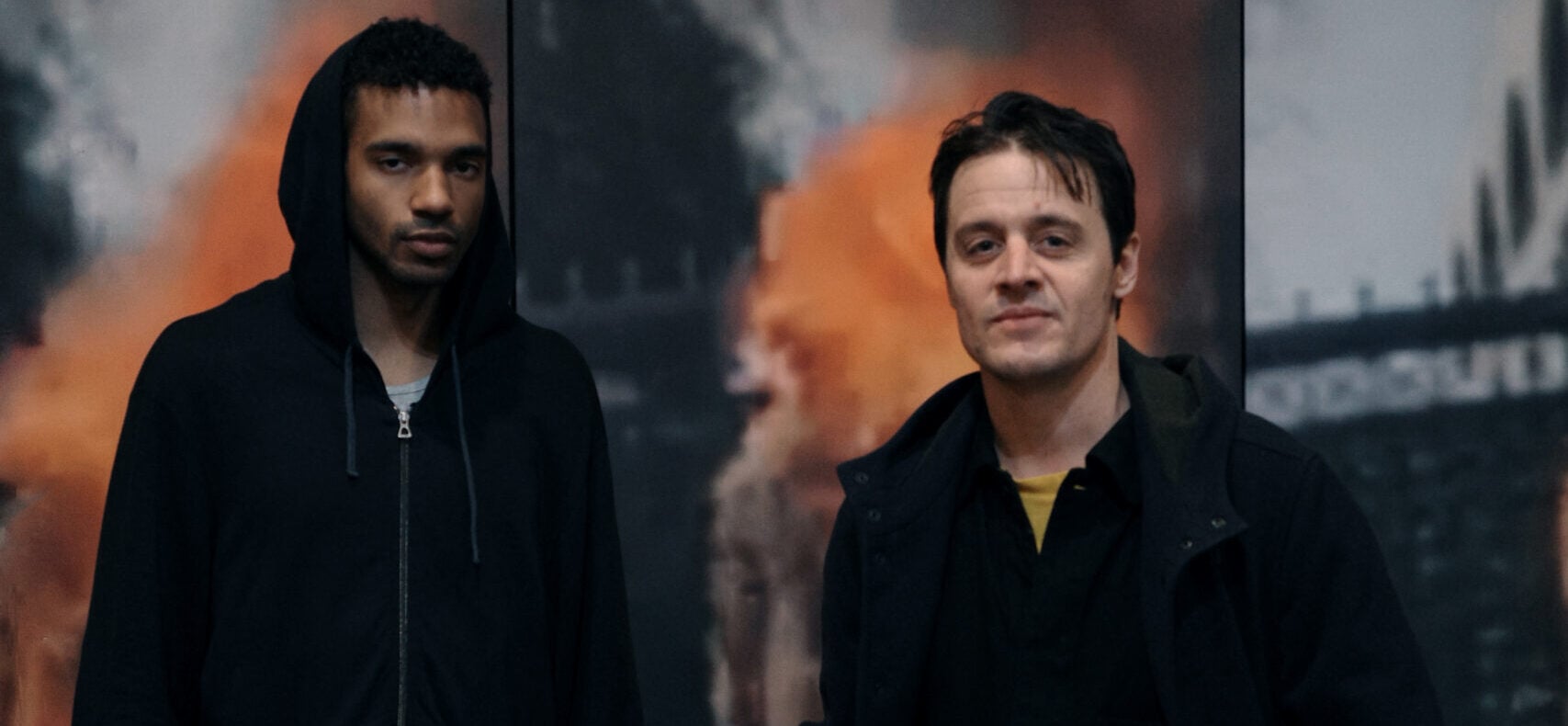
An indie film is turning heads after bypassing traditional Hollywood distribution with an underground launch that’s drawing sold-out crowds. The Indie Film Breaks The System With ‘Underground’ Launch first appeared on The Blast
When “Our Hero, Balthazar“ began filling theaters across New York and Los Angeles without a Sundance launch, a major festival platform, or a traditional studio campaign, the film industry was caught off guard. The people who actually built the release, however, were not. The film, directed by Oscar Boyson and featuring an ensemble cast led by Jaeden Martell, Asa Butterfield, and Noah Centineo, alongside Avan Jogia, Chris Bauer, Jennifer Ehle, Anna Baryshnikov, Becky Ann Baker, and Pippa Knowles, launched in tandem with a fine art exhibition in a raw Brooklyn warehouse, with no traditional studio campaign behind it.
Inside ‘American Wasteland’: When Hollywood Independence Collided With The New York Underground
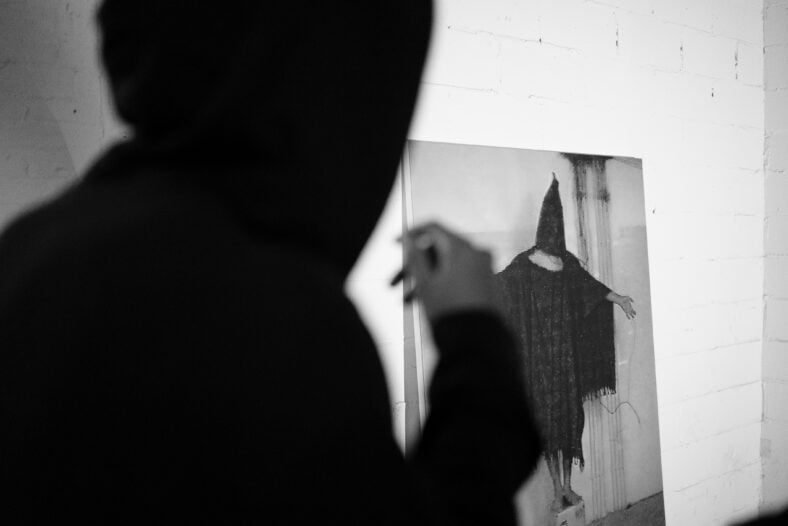
The exhibition, titled “American Wasteland,” was hosted by Relaispunkt, locally known as RP.1, the curatorial arm of Base 36, an independent cultural network that has built its own infrastructure outside the gallery establishment. Base 36 is the core; its projects are the extensions.
From Le Parti’s years of DJing and running after-hours and warehouse events out of his Brooklyn studios, the network took shape across cities: RP.1 operating out of Berlin, and across Los Angeles and Berlin, with a recurring presence in the Downtown Los Angeles and Skid Row area, “Play,” an after-hours and warehouse party, and “Sibyl,” an art advisory. All built on the same instinct: activate the space, own the infrastructure, don’t wait for permission.
The exhibition is the work of Jet Le Parti: a painter, poet, musician, and publisher whose practice has spent years accumulating force outside the channels that typically decide what gets seen. Where Boyson came up through the Safdie brothers’ orbit, producing “Good Time” and “Uncut Gems” before stepping into the director’s chair, Le Parti built his own orbit entirely. He is not an outsider artist in the romantic sense. He deliberately chose where to build, then built it.
When the two projects collided, it wasn’t a promotional alignment. It was two people investigating the same American crisis, arriving at the same room from opposite directions.
‘Our Hero, Balthazar’ Turns Rejection Into Sold-Out Success
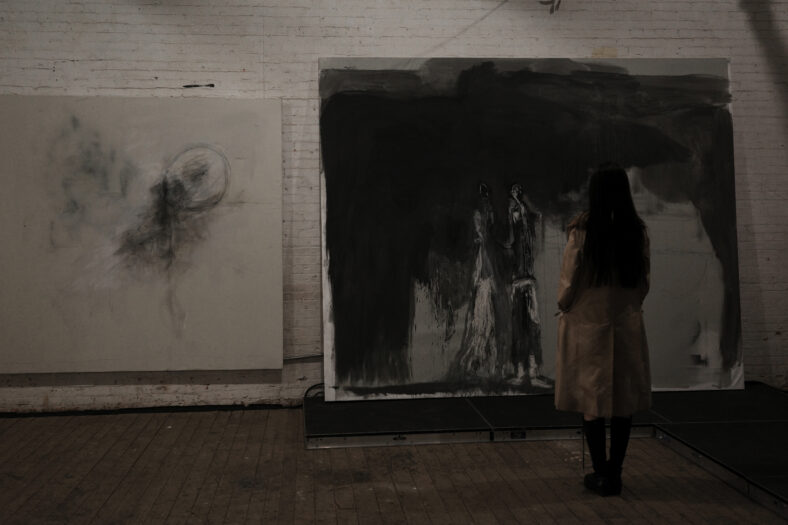
Image Credit: Relaispunkt.1
Oscar Boyson has spent his producing career inside a gritty, unflinching tradition of American independent cinema, films about people on the verge of coming apart. As a director, “Our Hero, Balthazar,” co-written with Ricky Camilleri, the former HuffPost journalist turned screenwriter, and executive produced alongside Halsey, is his most direct engagement with the consequences of a collapsing masculine mythology.
The film zeroes in on the specific cruelty of the environments teenage boys are placed inside, tracking the fallout of edgelord internet culture and the performance of masculine identity in the attention economy. Where most films about this terrain reach for sociological distance, “Our Hero, Balthazar” stays close: drawing from the raw, proximate lineage of Larry Clark’s “Bully,” the performances refuse the safety of retrospective judgment. The team approached the release not as a standard theatrical run but as a deliberate cultural act: a film meant to be encountered inside an exhibition that was already asking the same questions.
When the film was turned away by Sundance and SXSW, the team refused to wait for permission to exist. They found a shared ethos in Peter Gold at WG, who architected the unconventional distribution play. Through a pipeline coordinated between WG, Picturehouse, Arkhum Media Rights, and Base 36, the film went directly to audiences. Base 36 and RP.1 connected their community to it, driving turnout, moving tickets, and contributing to multiple sold-out screenings across New York. It didn’t need a traditional campaign. It needed the right people in the right rooms.
This Exhibit Takes A Shocking Look At American Decay
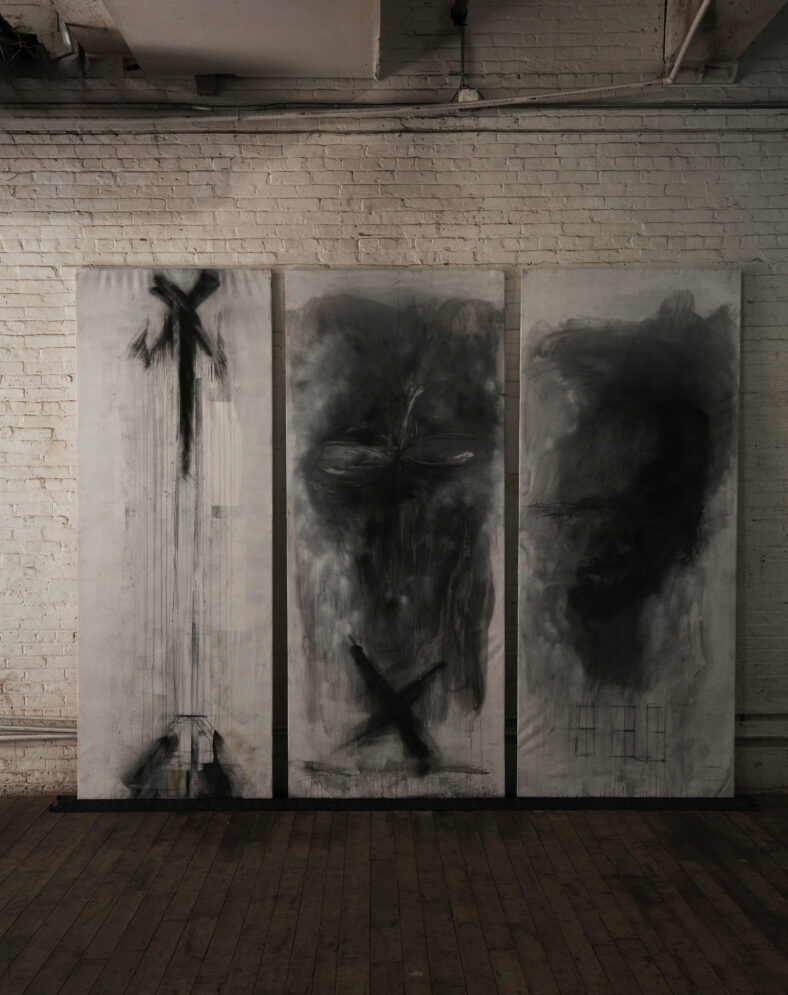
Image Credit: Relaispunkt.1
The film’s reception cannot be separated from that room. Le Parti transformed the warehouse into an extensive study of late American decay, operating, as he typically does, outside the permitting logic that governs institutional spaces. His is a practice of accumulation and witness: he grew up in the American South inside the military apparatus, and his work has never metabolized that origin cleanly. What remains is violence absorbed as atmosphere, institutional failure rendered as aesthetic fact, the fatigue of endurance as formal principle.
“Rocketman,” a work by London-based Base 36 artist L.S. Toy, offers a frame-by-frame, photorealistic rendering of active-duty airman Aaron Bushnell’s self-immolation in protest of the Gaza war, holding the image at the scale the decision deserves. Toy’s practice is built around media-heavy subject matter: hyperrealistic paintings of scenes drawn directly from news coverage, political commentary rendered in industrial greyscale, and works that have tested the legal boundaries of image and currency.
‘American Wasteland’ Blurs Line Between Real And ‘Simulated’ Violence

Image Credit: Relaispunkt.1
Nearby, Le Parti’s “Pawn Shop” reconstructs the police scene from the street where his own brother was shot, refusing the distance between private catastrophe and public history. Alongside military diagrams and works like “Sisyphus,” treated here not as classical allusion but as a lived condition, the myth stripped of its consolations, the exhibition features collaborative image-works by Reign.925, the visual project of “Le Parti and Toy,” created together, where school-shooting imagery bleeds into “Call of Duty” aesthetics without ironic distance. The effect is a kind of double exposure: real violence and its simulation rendered indistinguishable, which is precisely the point.
The triptych “Phases of the Nuclear Option” maps the procedural steps toward annihilation in the calm, bureaucratic language of the military itself, the aesthetic of institutional inevitability. At the center of the exhibition is “Ramble,” a long poem from Le Parti’s self-published debut manuscript “Every Day Is a Countdown,” which tracks the evolution of modern violence from the manosphere to the mainstream. The show is, in essence, his poetry made spatial, a poet who refused to soften his language for traditional publishing and who built the room to hold it instead.
Noah Centineo Backs ‘Underground’ Art-Film Collaboration
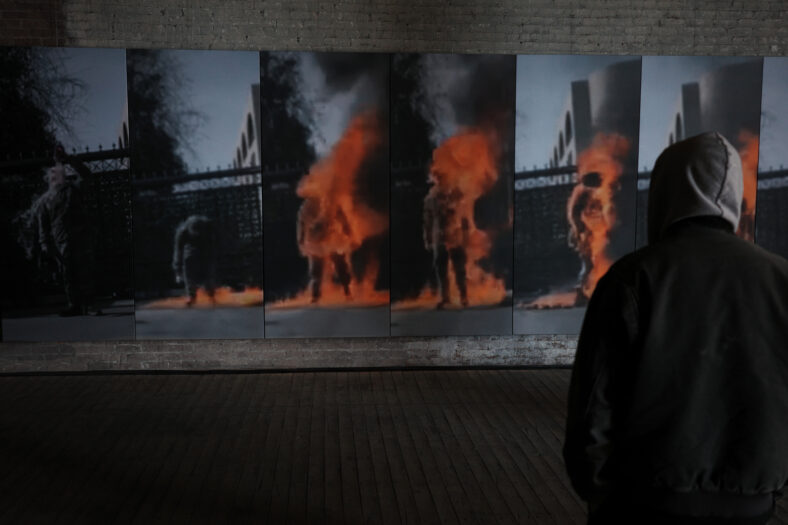
Image Credit: Relaispunkt.1
The two projects grew from relationships outside the usual industry circles, and from a conversation that began, as many things in Le Parti’s orbit do, through Converting Culture, his editorial platform and magazine. It was there that the idea for the exhibition first took shape as something more than an idea: a felt necessity.
Noah Centineo, who appears in Boyson’s film and had long been a collector of Le Parti’s work, and Enzo Marc, whose Arkhum banner is also attached to the film as a production company, came in behind it together. Nobody was waiting on a grant. It came from people who already believed in each other’s work.
During the exhibition’s opening, Boyson articulated the link connecting the two mediums, asking: “Why does dark humor feel like the only way to find catharsis amongst the horror show we’re living in? And what would you call the horror show we’re living in? I mean, it’s the American wasteland, man.”
Le Parti’s answer was blunt. It’s all just atmosphere now, he said, people wake up, see a child die online, scroll to delivery options, order something, share a story, move on. Extreme violence has become ambient, absorbed into the scroll. Words are just noise. Maybe the art is too. But we’re still recording it. What Le Parti is describing is less a failure of empathy than a structural condition: a culture so saturated with images of its own catastrophe that outrage has become another content category. The exhibition doesn’t solve that. It just refuses to look away.
And the film, in its own way, is proof of the same condition. You don’t arrive at dark comedy about school shooters as a viable form of entertainment unless the culture has already done the work of normalizing the subject matter. “Our Hero, Balthazar” could only exist, could only find an audience willing to laugh and wince and sit with it, because the ambience Le Parti is describing has already settled in. The film isn’t commenting on desensitization from the outside. It was made from the inside. That’s what makes it a document as much as a film, a timestamp of exactly where America is right now, rendered in the only register the moment could hold.
‘American Wasteland’ Challenges How Stories Reach Audiences
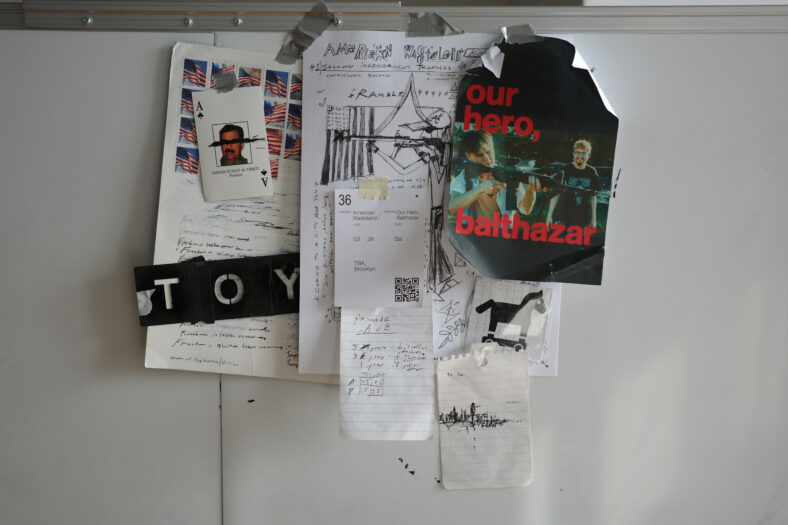
Image Credit: Reliaspunkt.1
Neither the film nor the exhibition is context for the other. They are operating on different registers of the same problem. Le Parti works at the systemic level, the military apparatus, the cultural infrastructure that normalizes violence, the long American tradition of absorbing catastrophe without consequence. Boyson works at the phenomenological level, two boys, one country, the specific texture of the damage done. The distinction matters: one maps the structure, the other inhabits it. Together, they argue that neither register is sufficient on its own.
Together, they pulled off what the conventional apparatus could not, and would not. “American Wasteland” and “Our Hero, Balthazar” didn’t prove a theory about independent distribution. They proved something older: that when the work is honest, and the room is right, the audience finds it. Institutions are optional.
“Our Hero, Balthazar” is currently in distribution through Picturehouse. “American Wasteland” was presented by RP.1 / Base 36, featuring works by Jet Le Parti, L.S. Toy, and Reign.925. “Every Day Is a Countdown” by Jet Le Parti is available through Base 36.
The Indie Film Breaks The System With ‘Underground’ Launch first appeared on The Blast
 Is Beyoncé Dropping A New Album After Next Week’s Met Gala? Source Says…
 Cynthia Erivo Pauses Show To Call Out Filming Fan
 Rita Wilson Told Tom Hanks To ‘Be Sad’ After Breast Cancer Diagnosis
 Sterling K. Brown Stands By Posting Sons For Safety
 Taylor Swift And Jack Antonoff Shut Down Feud Rumors In Separate Interviews